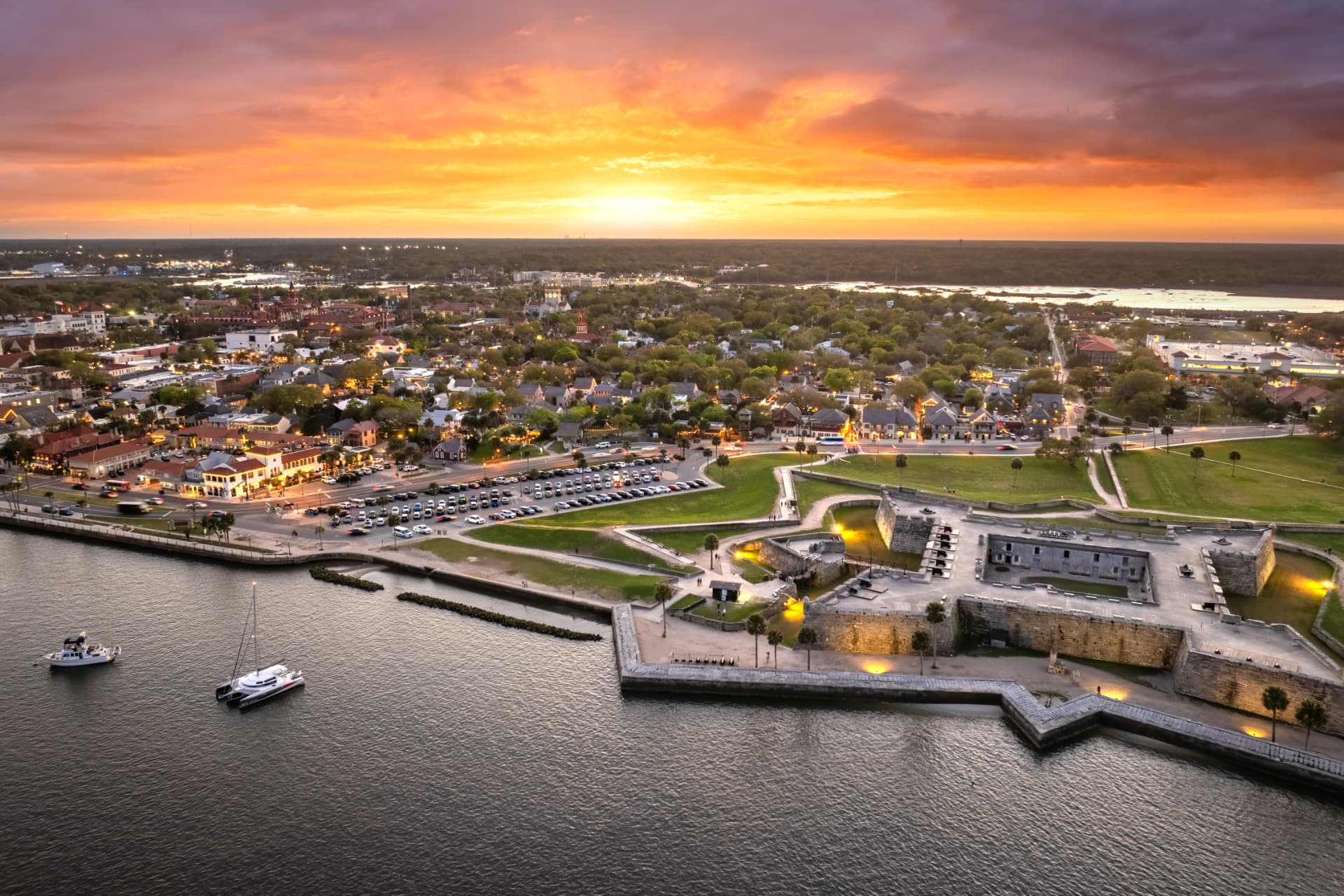
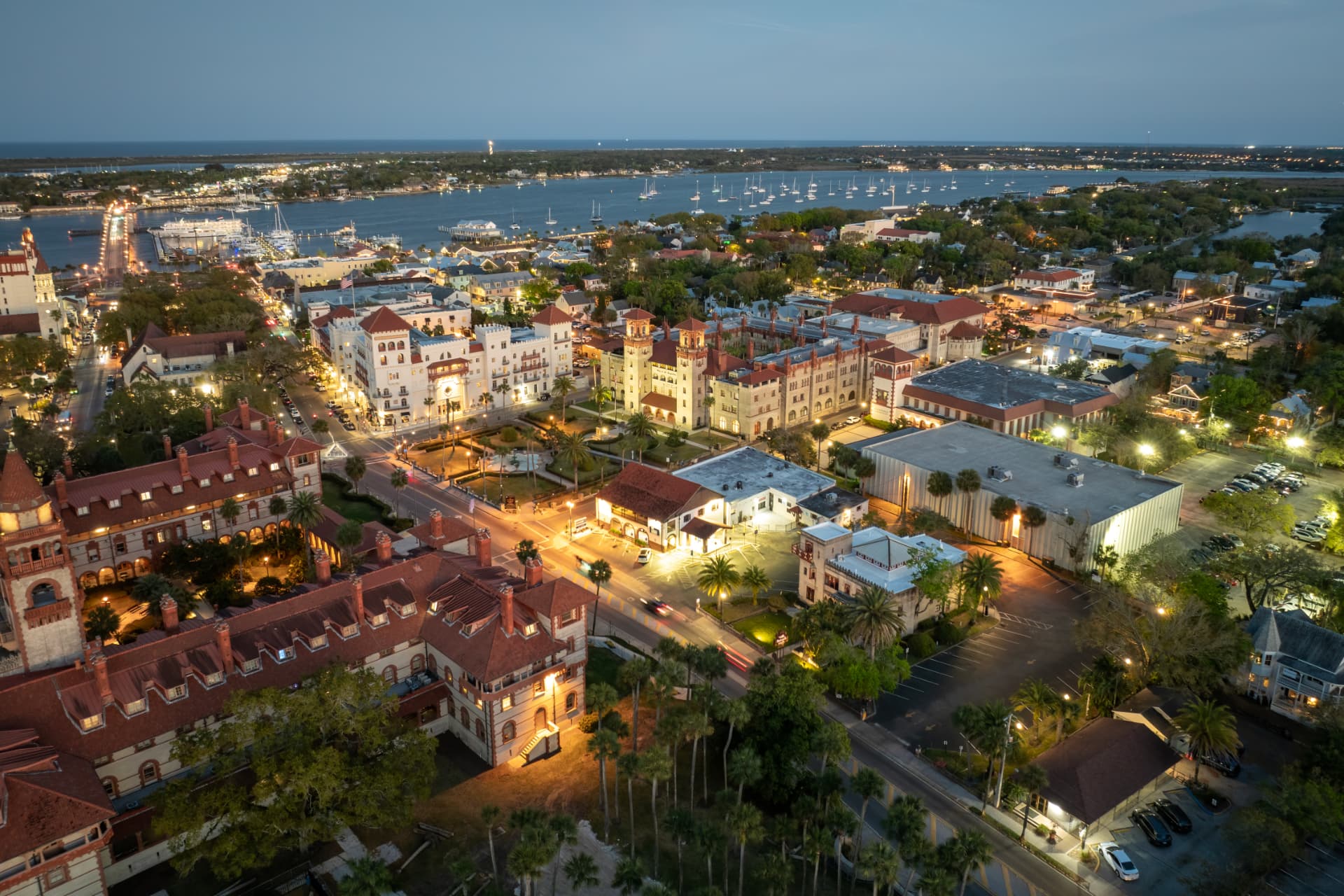
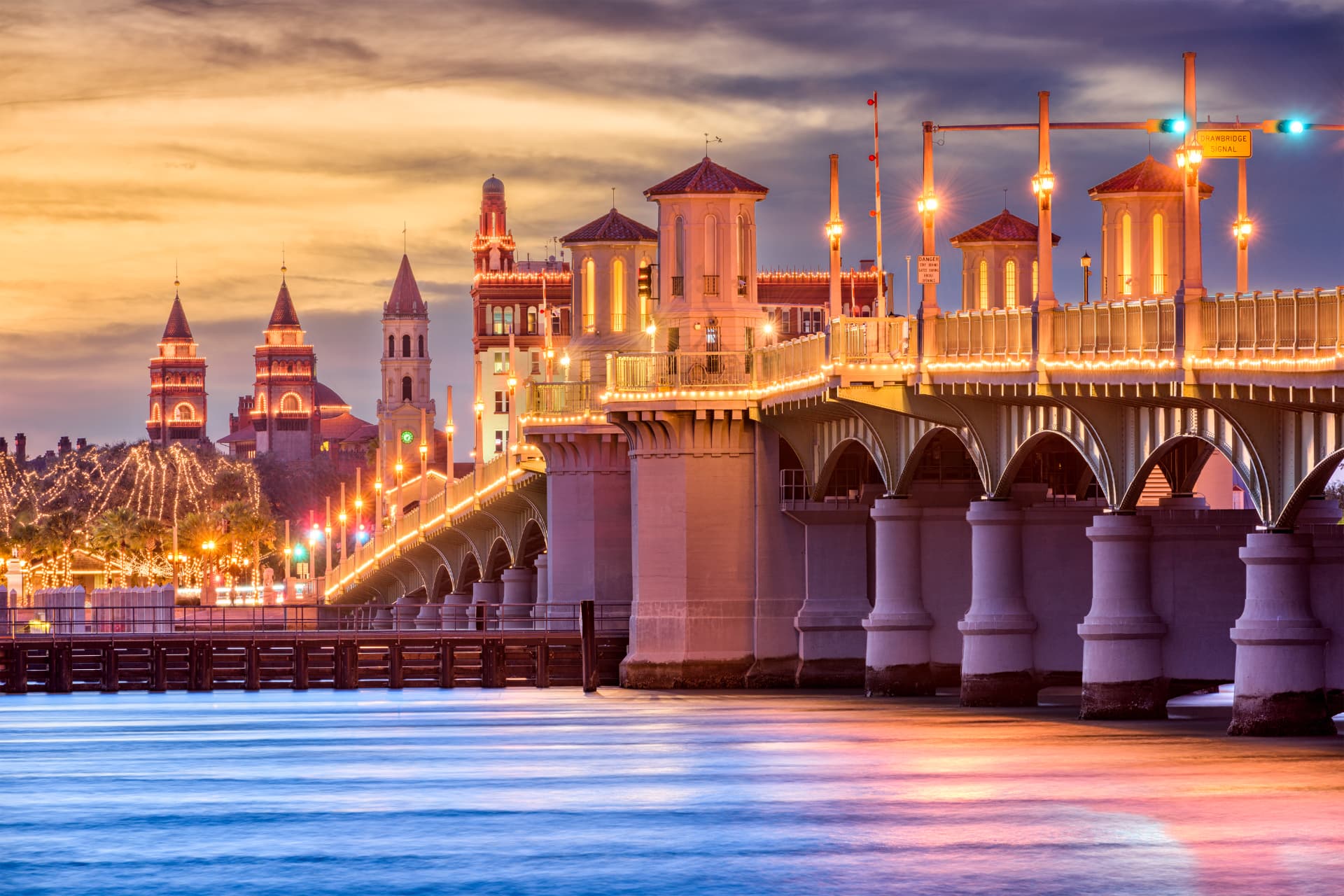
Aerial view over St. Augustine's red-tile rooftops and palm-lined streets glowing at twilightThe Bridge of Lions lit up at sunset with historic spires beyond the waterAerial view of the Castillo de San Marcos at sunset with the old city beyond
St. Augustine — 462 years of history

St. Augustine, Florida

Walk 462 years of the Ancient City

Four self-guided routes through America's oldest city — stop-by-stop stories, an easy map to follow, and your own pace. Every tour is free.

Always free — no ticketsSupported by local businesses
View Free Tours

No app, no sign-up — it all runs in your browser.

free routes
4free routes
each, at your pace
1–2 mieach, at your pace
story stops
40+story stops

The Ancient City

America's oldest city is small enough to walk and old enough to surprise you

St. Augustine was founded in 1565, four decades before Jamestown, and it has been lived in ever since. That continuity is what makes it worth walking rather than driving: Spanish colonial coquina, a British-era street grid, an American town square, and Henry Flagler's Gilded Age palaces all sit within a few blocks of one another on the same narrow lanes.

The historic district measures barely a square mile. From the Plaza de la Constitución you can reach the Castillo de San Marcos, the Cathedral Basilica, Flagler College and the bayfront in under ten minutes on foot. Almost nothing here needs a car — which is exactly why a self-guided walking tour is the honest way to see it.

Our four routes each take a different thread through that history. Walk one in a morning, or link them across a weekend and you will have covered the founding shoreline, the colonial core, the resort boom and the water that made all of it possible.
1565
Year founded
462
Years of continuous history
~1 sq mi
Walkable historic district
40+
Story stops across four routes

462 years in six moments

A short history of St. Augustine, and where you can stand in it.

  1. 1565

    Spain founds the city

    Pedro Menéndez de Avilés comes ashore and claims the settlement of St. Augustine for Spain — 42 years before Jamestown and 55 before Plymouth, making it the oldest continuously occupied European-founded city in the continental United States.

  2. 1672–1695

    The Castillo rises

    After raids and fires destroyed a succession of wooden forts, Spain built the Castillo de San Marcos from coquina — a shell stone quarried on Anastasia Island that absorbed cannon fire rather than shattering. It has never been taken by force.

  3. 1763–1784

    Two decades under Britain

    Spain traded Florida to Britain for Havana. St. Augustine became the capital of British East Florida and a loyalist refuge during the American Revolution, before returning to Spanish hands twenty years later.

  4. 1821

    Florida becomes American

    Spain ceded Florida to the United States, and the Plaza de la Constitución — laid out under Spanish law and still the heart of downtown — began its life as an American town square.

  5. 1888

    Flagler's resort city

    Henry Flagler opened the Hotel Ponce de León, a Spanish Renaissance palace of poured concrete and Tiffany glass, and turned the sleepy old port into America's first winter resort. It is now Flagler College.

  6. 1964

    A civil rights turning point

    Demonstrations in St. Augustine, including arrests at the Monson Motor Lodge, drew national attention and helped push the Civil Rights Act of 1964 through Congress. Markers along the Plaza tell this story.

What you'll walk through

The historic district is a handful of distinct neighborhoods pressed together. Here is what each one gives you.

The Colonial Quarter & St. George Street

A pedestrian-only spine of coquina walls, balconies and courtyards running from the city gates to the Plaza. Expect the oldest streetscape in the country, plus the shops and bakeries packed into it.

Covered on The Ancient City Core

Plaza de la Constitución

The 1573 town square: public market, Cathedral Basilica, Civil War and civil rights monuments, and the shade of live oaks. Nearly every route passes through it.

Covered on The Ancient City Core

Flagler's Gilded Age campus

Flagler College, the Lightner Museum in the old Alcazar Hotel, and Memorial Presbyterian Church — three blocks of 1880s Spanish Renaissance ambition built in poured concrete.

Covered on Flagler's Gilded Age

The bayfront & Bridge of Lions

Avenida Menéndez along Matanzas Bay, the seawall, shrimp boats, and the marble lions guarding the 1927 bridge to Anastasia Island. Best light in the city at sunrise.

Covered on Bayfront Breeze

North City & the Mission grounds

Quieter streets above the Castillo leading to the Mission of Nuestra Señora de la Leche, the Fountain of Youth grounds and the marshy shore where the city actually began.

Covered on North City Origins

Lincolnville

A late-1800s neighborhood founded by formerly enslaved residents, with the city's largest concentration of Victorian homes and a central role in the 1960s civil rights movement.

Nearby detour from the Plaza

How it works

Open a route in your browser and start walking. No app, no account, nothing to buy.

Follow the map

An embedded map follows each stop, and Guide me uses your phone's GPS to walk you to the next one with distance and direction.

Listen as you go

Every stop can be read aloud — the story, what to look for, and where to walk next — so you can keep your eyes on the street.

Save your favorites

Heart the tours you like and track which stops you've already walked, so you can pick the route back up tomorrow.

Free, thanks to locals

No tickets ever. Independent cafés, shops and makers along each route are featured as local recommendations and keep the tours free.

Planning your walk in St. Augustine

Six things worth knowing before you set out on foot.

01

Wear real walking shoes

Much of the old town is uneven brick, coquina and crushed shell. Flat, closed shoes beat sandals here.

02

Start early or late

Before 10am the streets are quiet and cool; after 5pm the light turns gold and the day-trip crowds thin out.

03

Carry water and shade

Florida sun is unforgiving from May to September. A hat, sunscreen and a refillable bottle change the whole walk.

04

Look up, then look down

Balconies, coquina blocks and hand-cut shutters are above eye level; tabby sidewalks and old survey markers are below it.

05

Leave the car parked once

Everything on these routes is within about a half mile of the Plaza. Park once, walk all day.

06

Support a marked local spot

The featured recommendations along each route are the reason the tours stay free. A coffee goes a long way.

Frequently asked questions

Are the walking tours really free?

Yes. Every route on this site is free to use, with no tickets, no sign-up and no paywall. The tours are funded by independent St. Augustine businesses that appear as clearly marked local recommendations along each route.

Where should a first-time visitor start?

Start with The Ancient City Core. It is a 1.3-mile loop covering St. George Street, the Plaza de la Constitución, the Cathedral Basilica and the Castillo de San Marcos — the densest concentration of history in the city and the best orientation to how the old town fits together.

How long does a self-guided tour take?

Each route is 1 to 2 miles and takes roughly 45 to 90 minutes of walking. Because you set the pace, most visitors spend two to three hours once they stop for photos, courtyards, coffee and a look inside the sites they pass.

Do I need to download an app?

No. Everything runs in your phone's browser. Open a tour, allow location when you want turn-by-turn guidance, and the map follows you from stop to stop. You can also have each stop read aloud.

When is the best time of year to walk St. Augustine?

October through April is the most comfortable, with mild, dry days in the 60s and 70s. Summer is hot and humid, so walk early morning or after 5pm and carry water. November through January adds the Nights of Lights displays after dark.

Is St. Augustine walkable, and are the routes accessible?

The historic district is compact and almost entirely walkable — most of these routes stay within a half-mile radius of the Plaza. Sidewalks are good on the main streets, though some lanes have narrow walks, coquina curbs and uneven brick, so wheelchair users and strollers may prefer the bayfront and Flagler routes.

Where do I park before starting a tour?

The Historic Downtown Parking Facility on West Castillo Drive is the largest garage and sits a two-minute walk from the Castillo and the city gates, making it the easiest place to leave a car before any of these routes. Street parking in the old town is metered and limited.

Ready to walk the Ancient City?

Pick a route, put your phone in your pocket, and let the city do the talking. Every tour is free — kept that way by the local businesses you'll pass along the way.